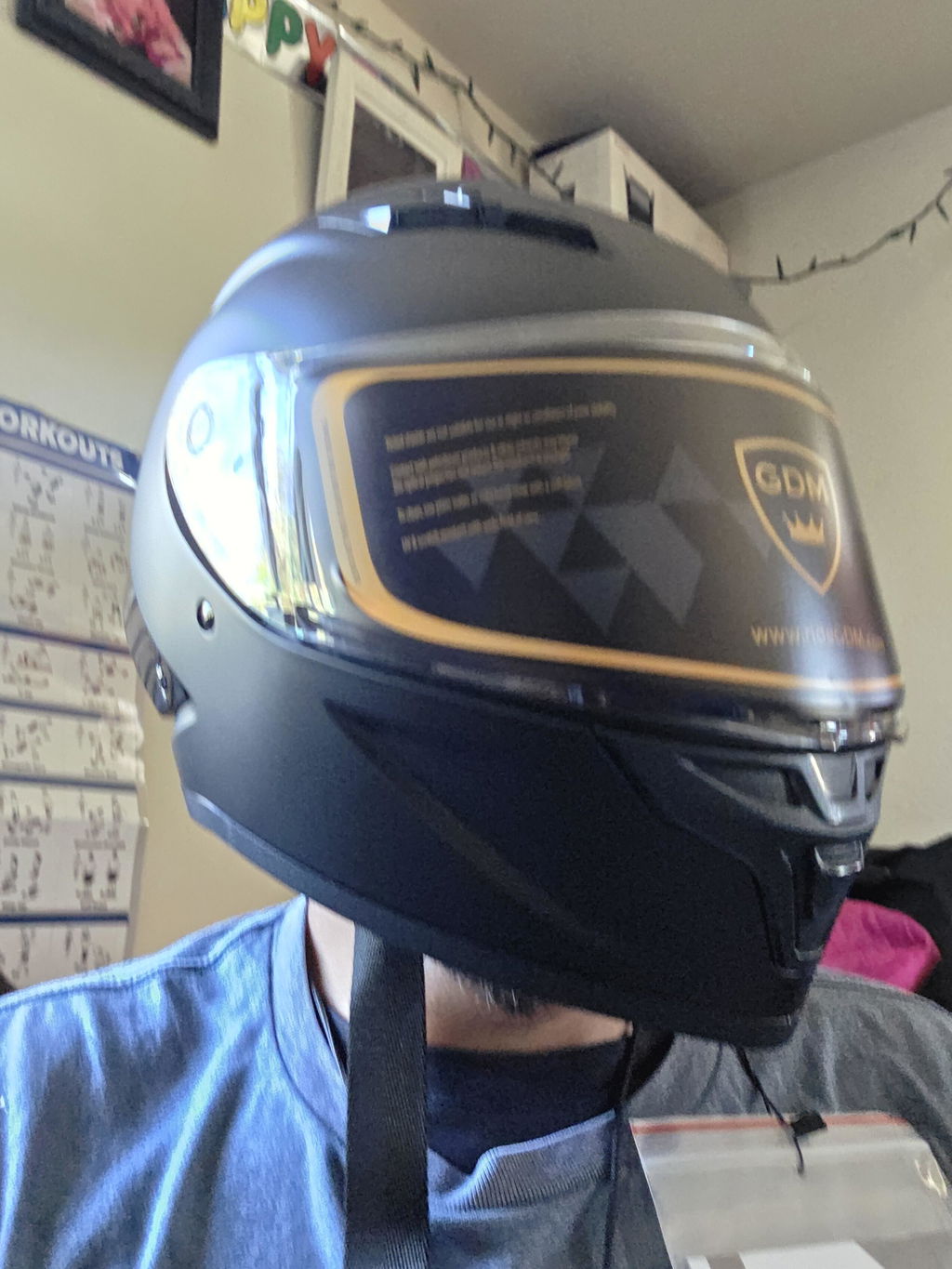
A sport bike puts you in a forward lean, with your head tilted up to see the road, often at higher speeds than a cruiser or a scooter. That changes what you need from a helmet. Here's what to look for in a sport bike helmet, from the view out of the eye port when you're tucked in to the shell shape, the vents and the shields.
Quick answer
- Wear a DOT-certified full face helmet. It's the only type with a chin bar.
- Check the view from your riding position, not just standing up.
- Look for a smooth, aerodynamic shell with a rear spoiler, which helps it stay stable at speed.
- Get a snug fit. A loose helmet lifts and shakes in the wind.
- Carry two shields: clear for night, tinted or mirrored for sun.
Why sport bike riders wear full face helmets
Sport riding means higher speeds, quick direction changes and a riding position that puts your face out in front. In a crash, the chin and face often take a hit, and a full face helmet is the only type that covers them. Its shield also keeps wind, bugs and debris out of your eyes. If you're weighing other styles, see what makes a motorcycle helmet safer.
Check the view in a tuck
On a sport bike, your back is angled forward and you look up through the top of the eye port. A helmet that gives a great view when you're standing can put the top edge of the eye port right in your line of sight when you're on the bike.
Try the helmet on and sit on your bike in your normal riding position. Look ahead at the road, then up into an imaginary turn. You should see the road clearly without straining your neck or seeing the helmet's brow edge. Check your mirrors too.
Aerodynamics and stability
A sport bike helmet takes the wind at a different angle than a helmet on an upright bike. A smooth shell and a rear spoiler help it cut through the air without lifting or buffeting, so your neck works less at speed. That matters even more on a naked bike, where there's no fairing to block the wind.
Buffeting can also come from the bike's windscreen. If the helmet shakes at speed, try a slightly different riding position before blaming the helmet. More in aerodynamic helmets for highway riding.
A snug fit matters more at speed
At highway speeds, a loose helmet lifts, shakes and lets in more wind noise. A sport bike helmet should feel snug all around, with the cheek pads pressing firmly. New helmets feel tight at first and loosen as the pads break in; see how to break in a new helmet to tell normal snugness from a bad fit.
The chin strap matters too. Most sport helmets use a double D-ring strap, which you can pull tight and which doesn't slip.
Vents you can control
Full gear on a hot day gets warm fast, especially in traffic. Look for a chin vent, forehead vents and a rear exhaust. Open them in town, and close the chin vent at speed if the noise gets too loud. See how helmet ventilation works.
Shields: clear for night, tinted for sun
A flush-fit shield that sits tight to the shell cuts wind noise and looks clean. Sport riders often ride from bright afternoons into the evening, so it's worth having two shields: a clear one for night, dusk and rain, and a tinted, iridium or chrome one for the sun. Never ride with a dark shield at night. See which visor color to use when.
Bluetooth without the bulk
A headset lets you hear GPS directions, take calls and talk to a riding partner without taking your hands off the bars. Mount it so it doesn't stick out too far from the shell, and route the wires so nothing presses on your ears. You can add a headset to the helmet you have, or get a helmet that comes with one, like the GDM DEMON HyperSonic or the GDM GHOST2 with Bluetooth.
Going to the track?
Track day organizers set their own helmet rules, and many require a specific certification such as Snell or ECE. GDM helmets are DOT FMVSS-218 certified for the street. Check your organizer's rules before you book.
The rest of your gear
Speed and a forward lean also mean you need protection for the rest of you. A leather jacket like the GDM DELTA leather racing jacket, armored gloves like the GDM GD5 or GD7, and good armor make a full set. See CE Level 1 vs Level 2 armor to choose your pads.
GDM full face helmets for sport bikes
All four are DOT FMVSS-218 certified, with a lightweight composite poly-alloy shell, a rear spoiler, 5 points of ventilation, a flush-fit shield, a removable and washable liner, and a double D-ring chin strap. Each comes with 2 shields.
- GDM DEMON: an aggressive shell in matte black.
- GDM VENOM: sharp shell lines, in matte black or pearl white.
- GDM GHOST2: a sleek aerodynamic profile for commuting, canyon runs and touring.
- GDM Ghost: a clean, all-black look with no graphics.
Compare them all in our full face motorcycle helmets, and pick up extra replacement shields and visors.
FAQ
What kind of helmet do sport bike riders wear?
Almost always a full face helmet, because it's the only type with a chin bar and a full face shield. Look for one that's DOT-certified, snug and stable at speed.
Do I need a special helmet for a sport bike?
You don't need a special type, but a full face helmet with a smooth shell, a good view when you're tucked in and a snug fit suits sport riding.
Why does my helmet lift at high speed?
Usually because it's a little loose, or because of how the wind comes off your windscreen and hits the helmet. Check the fit and the chin strap first, then try a slightly different riding position.
Can I wear a modular helmet on a sport bike?
You can, but most sport riders choose a full face helmet. See modular vs full face helmets for the differences.
Can I use my street helmet on a track day?
It depends on the organizer. Many require Snell or ECE certification, so check their rules before you go.